



Signal and Equipment
Should I Wash My Hair Before a Session?
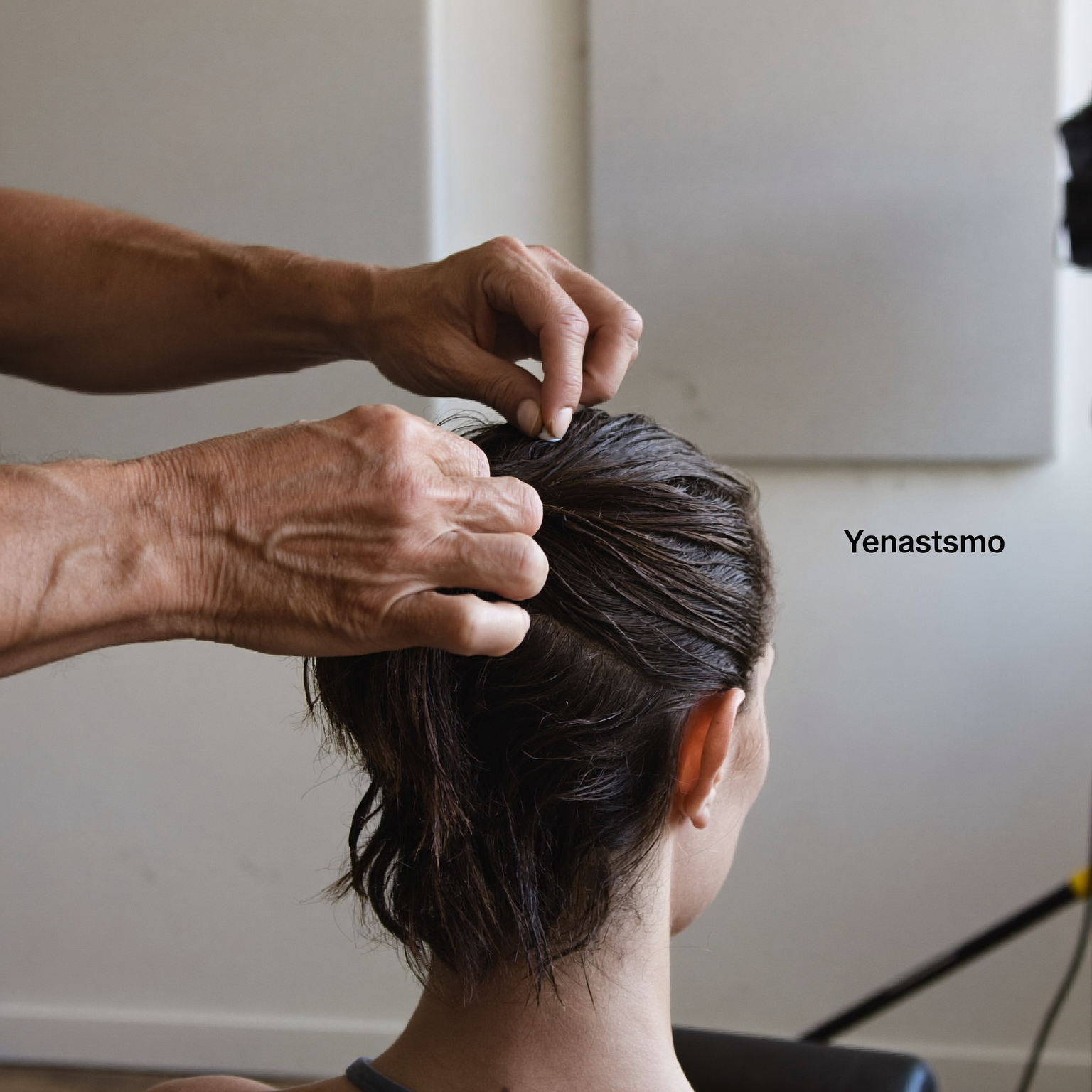
Learn how clean, dry hair, light styling products, and simple hairstyles make scalp sensor placement easier before a studio session.
16 September 2026. 6 minute read.

Signal and Equipment
By the session practitioner. Published 24 February 2026. Updated 24 February 2026. 4 minute read.

The 10-20 system is an international naming convention for positions on the scalp. Positions are set by measuring the head and spacing points at ten percent and twenty percent intervals along those measurements, which is where the name comes from.
It is a map with agreed labels. It does not describe what happens at a position, only how to find the same position again on the same head, or on a different one.
From two measurements taken with a tape. One runs front to back, from the bony bump at the base of the skull to the dip above the bridge of the nose. The other runs across, ear to ear.
Those distances are divided into proportional steps. Points sit at ten percent from each end and then at twenty percent intervals between. Because everything is proportional, the system works on a small head and a large one without changing the labels.
That proportional design is the clever part. A fixed grid in centimetres would land in different relative places on different people. Percentages do not.
Each label has a letter for the general region and a number or a letter for the side. F is frontal, C is central, P is parietal, O is occipital, and T is temporal.
Odd numbers sit on the left, even numbers on the right, and z stands for zero, meaning the centre line. So Cz is the central point on the midline, roughly the top of the head. F3 is a frontal point on the left.
That is the entire code. Once you know it, a placement note like Cz and behind both ears stops looking like jargon and starts looking like an address.
Because the alternative is describing placement in prose, and prose is not repeatable. A note reading a bit forward of the crown, slightly left means one thing to the person who wrote it and something looser to everyone else.
Using the convention also makes a record legible to somebody outside this practice. If you take your session history elsewhere, a position label travels. A phrase does not.
It is worth being clear about what borrowing the convention does not do. Using a research naming system does not make a session a research procedure, and it does not import anybody else's findings into what we offer.
Not necessarily. Placement can change between visits, and when it changes the reason is written next to it in the record.
What stays constant is the vocabulary. If your second session used different positions than your first, both are named the same way, so the difference is visible rather than buried.
You can ask to see your placement record at any time. People rarely do, and the ones who do tend to be the ones who keep their own notes, which we like.
Measures, marks, and tells you what they are doing while they do it. It takes a couple of minutes and involves being touched on the head, which is worth knowing in advance if that bothers you.
The marks are made with a washable pencil or with the paste itself, not with anything permanent. They come off with the same wash that removes the paste.
If you would rather the measuring happened before anything else, say so at the start. Front-loading the physical part suits some people better than having it interleaved with conversation.
This is where careful language matters. A position determines where a very small signal is applied. It does not determine an outcome, and we will not tell you that one label produces one result.
Claims of that kind exist in marketing material and they run ahead of what the record supports. Our page on what we do not know is honest about how much of the placement question remains open.
What placement does give you is comparability. If a series of sessions is run with recorded positions and recorded durations, you can look back at the series and see what varied. Without the record, you are relying on memory of how a Tuesday felt.
Our sensor placement page covers the same convention in the context of a session, including what the paste is and how contact quality is checked. The signal page covers the other half of the question, which is what is being applied once a position is chosen.
The glossary is the shortest route if you just want a definition for a term you saw on another site and want to check it against a plain one.
Because heads differ, and a fixed grid measured in centimetres would land in a different relative place on every person. A proportional system measures your own head and divides those distances, so the same label describes a comparable position across very different skulls.
That property is what makes written records legible to somebody else. A note that says a position by name can be reproduced by a different person on a different day without guessing what was meant.
It is also why the naming convention outlived the equipment it was designed around. The map is a measuring convention rather than a claim about what any position does.
Your Care and Comfort Matter
Momentous Neurofeedback is a wellness practice using advanced neurofeedback technology to support relaxation and nervous system regulation.
The IASIS i2 Relaxation Neurofeedback System is an FDA-cleared biofeedback device indicated for relaxation training and muscle reeducation.
Our services are not a substitute for medical care, we do not provide medical care, and we do not assess or identify health conditions. Individual experiences vary. If you have questions about your health or whether neurofeedback is appropriate for you, please speak with your licensed healthcare provider.
We are always happy to answer questions about what we do and what you can expect before your first visit.
About the Author
Session practitioner
Sessions and equipment log
Runs sessions across the week and keeps the equipment log. Prefers a slow start over a full schedule.
Talks people through what a session feels like, including the parts that feel like nothing at all.
Signal and Equipment
Learn how clean, dry hair, light styling products, and simple hairstyles make scalp sensor placement easier before a studio session.
16 September 2026. 6 minute read.

Sleep and Shift Work and Sessions
A wind-down routine assumes darkness and a quiet house. Night shift work removes both. What changes, and what still works.
10 March 2026. 5 minute read.

Signal and Equipment and Regulatory and Claims
The phrase covers several unrelated services that share only the size of the current. Here are the questions that tell them apart.
2 March 2026. 2 minute read.